







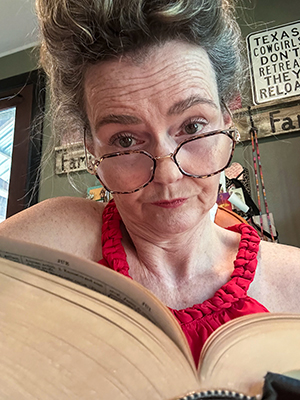
By Patti Parish-Kaminski, Publisher
Scouring my dictionary for phrases that don’t make a lick of sense.
I like words. I like to write them. I like to read them. I have my own personal library of favorite books, and yes, I reread them from time to time. It’s comforting to me, like catching up with a dear friend you haven’t seen for a while.
But this fascination with words lends itself to me pondering, which can be quite perplexing and downright frustrating at times. Mr. Kaminski hates it when I ponder as it typically leads to in depth conversations, which directly conflicts with his tv time.
A couple of years ago, I began a foray into audio books. Like I didn’t have enough books to read. I blame my GF Leslie on this one. She introduced me to the concept, and I bought it – hook, line and sinker.
And so it beings. The literal phrase of “hook, line and sinker” lends itself perfectly to my issue today. While listening to books, I have noticed extremely odd phrases that truly do not depict their literal meaning. Now, I’ve read them – and actually used some of them for years – but when you hear them, they hit a chord, a dissonant one.
Here’s a few idioms that have really gotten under my skin, so to speak:
“Pay a visit” – Though the phrase is used to indicate visiting someone, why pay? Is there a fee? Why not just say visit?
“Can’t help but feel” – What? So, when you use the word “but” in a sentence, it basically negates everything prior to the aforementioned word. And another negative with “can’t?” I don’t get this at all. If you are all in your feels about something, own it and say you are feeling a particular kind of way about a situation. Negative and help are not required.
“Dress up” – Why not say dress nice or dress formal or wear business casual? Why are we going up – or down – with our attire?
“Cold turkey” – Is this particular breed of fowls known for their chilly nature? They’re not polar bears. The common use of this phrase is the “abrupt, complete cessation of taking a drug to which one is addicted.” Are turkeys known for their addictive behavior? I just don’t get it.
“Beat around the bush” – This is supposed to refer to folks who can’t get to the point. But why beat up bushes? Apparently, this idiom stems from 15th Century hunters. When bird or boar hunting, a group of men – of course – were called “beaters.” The beaters literally beat bushes to scare out game so the hunters could easily kill them. Hmm. I can think of a much more concise meaning for this, kind of like picking low hanging fruit.
“Falling out” – What exactly are you falling out of? It’s designed to be a break up of sorts, so why say you’re falling? Can you fall in?
Enough of this madness. I’m fixin’ to listen to my current audio book, Homer’s The Odyssey. I’m sure I’ll hear more terms that don’t make a lick of sense, but I guess I’ll stop now before I let my hound dog mouth overload my hummingbird ass. See y’all next week – on the porch!

Patti Parish-Kaminski
Follow Patti Parish-Kaminski on Facebook at www.facebook.com/OnThePorchWithPatti/ and on Instagram at instagram.com/ontheporchwithpatti/.